Where the show puts the talent
Production Trailers
When a show wants a crawler, the floor opens and a trailer closes around them. The set is a picture. The room is real, and it gets more rooms when someone pays.
Production trailers are how a galaxy films people who are stuck on Earth. After a stairwell, or at a time Zev already booked, the System AI moves a crawler into a vessel parked in the zone it can still reach. Cheap ones sit in the ground. Expensive ones float on the ocean. A company pays for the trailer on top of the advertising stipend. Borant does not own every program that rents one. Private shows buy their own hour, then borrow the bodies.
Cameras are usually invisible. A small staff waits aboard, a person or two, or a robot with a tablet. The crawler's sheet does not travel cleanly. Above the water the menus go dark. Some worn gear still answers a fist. That is the whole courtesy.
Interview sets
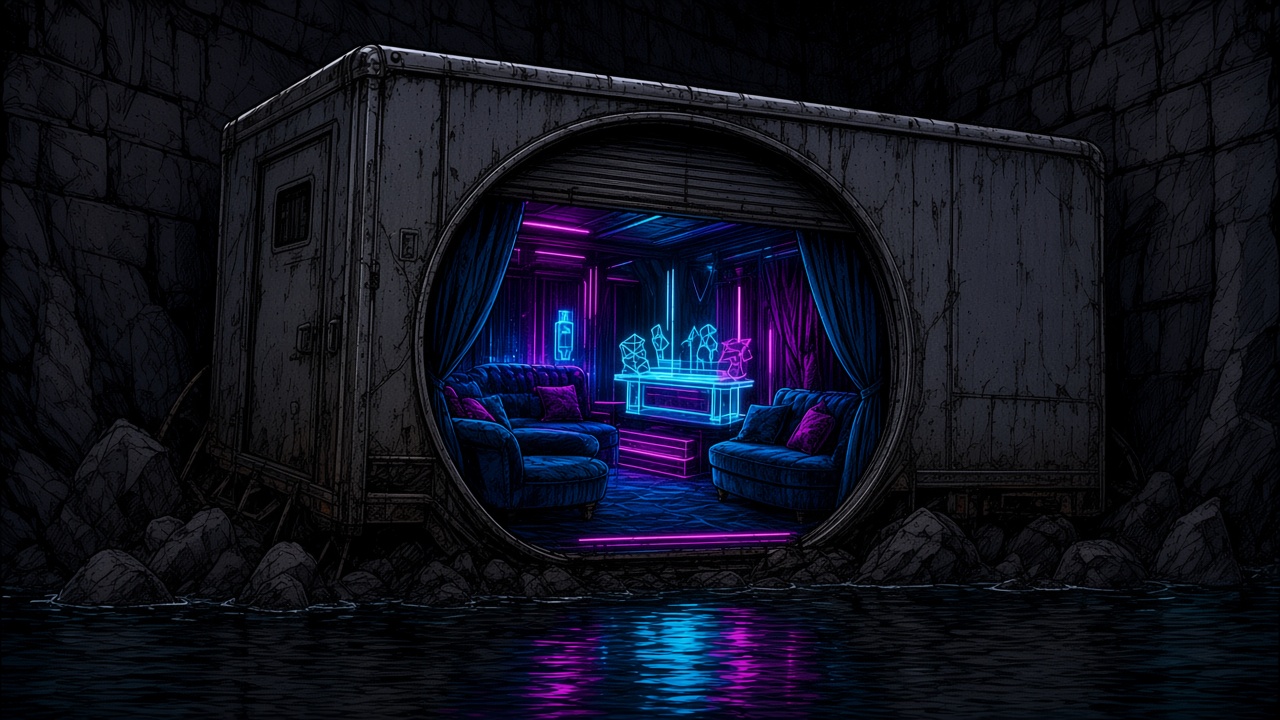
The interview starts before the host. A better trailer has a green room: somewhere to sit, a door that irises, and, early in the season, actual food. Dungeon Crawler After Hours with Odette introduces Carl and Donut to the type. Blue plush, a bar, fruit that is not a potion, a shutter door, and a bathroom with a porthole that is not glass and does not open. An associate producer briefs them there. The couch is furniture. Almost everything they will be praised for touching on air is not.
A bad booking skips the green room. Death Watch Extreme Dungeon Mayhem rents a plastic closet above the salt water, no windows, no snacks, a ceiling Carl can touch. Donut files this as a professional insult. She is right about the budget and wrong that the budget is the danger.
Shooting rooms
The shooting room is a projection. The crawlers stay in the trailer. The studio, the audience, the desk, and the host's half of the conversation are laid over them, closer to a holodeck than to a soundstage, and they cannot touch most of it. That is why a knife swung by another guest can pass through a person who is only present as a picture. Each show brings its own set. Odette gets a couch and a nebula. Death Watch gets a curved table and a loud room of boys. Danger Zone with Ripper Wonton gets a round table, hovering chairs, and a sign. The physical box underneath does not change to match. The picture does.
Rooms that show up as the show spends more
A trailer grows by invoice. The minimum is chairs in a closet. The next step is three rooms: green room, shooting room, bathroom. After that the amenities are the tell. A cleaning rig. A bar. A security trailer ridden under the ocean, still inside the zone, so the inventory opens again and the velvet is real. By the time the season is famous, the route to the set can include a stop that is not the trailer at all.
Spoiler · Book 1
The first Odette trailer is about the length of a modest boat, and Carl can tell from the motion that it is on the water. His menus are off. The gauntlet still comes when he closes his hand. Lexis, the associate producer, is the person in the green room. She is the one who has to explain that the set is a picture.
Spoiler · Book 3 · The Iron Tangle
Planet Beautiful pulls them into a lavish velvet room under the sea, a security trailer run by the same rental company Death Watch used. Because it is still inside the zone, Carl's inventory works. The robot on duty is happy to explain that Borant saved money on the lock.
Spoiler · Book 5 · The Hunting Grounds
Spoiler · Book 6 · Ghosts of Earth
By Shadow Boxer the transfer has gained a step. They go to a space station first, then down to an underwater trailer. The show is still a room with a couch. The hallway to the room is now infrastructure.